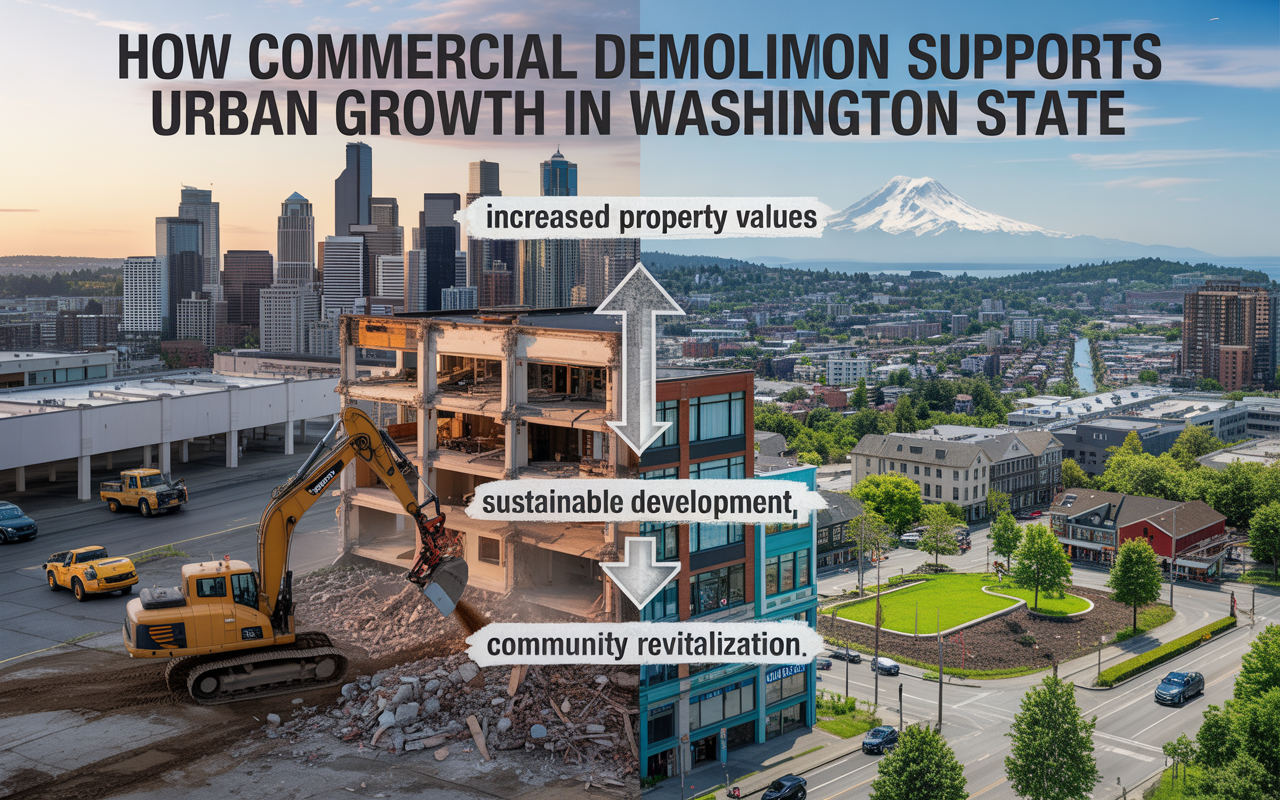
Washington State is changing fast. Drive through Seattle, Bellevue, Tacoma, or Spokane and you’ll see cranes dotting the skyline, new buildings rising where old ones once stood, and neighborhoods transforming to accommodate our growing population. Behind every new development, every revitalized district, and every modernized commercial corridor, there’s a critical first step that often goes unnoticed: commercial demolition.
Demolition isn’t just about tearing things down. It’s about making room for what comes next. As Washington’s cities evolve to meet the needs of growing populations and changing economies, commercial demolition plays an essential role in urban development. Let me show you how this often-overlooked industry directly shapes the growth and transformation happening across our state.
Clearing Space for Higher Density Development
Washington’s cities are growing vertically, not just outward. With limited land available in desirable urban areas and strong pushes for increased density, older low-rise commercial buildings are being replaced with taller structures that accommodate more businesses, more housing, and more people.
In neighborhoods like South Lake Union in Seattle, this transformation has been dramatic. What were once single-story warehouses and aging industrial buildings have given way to modern mixed-use towers. This only happens because commercial demolition crews can safely and efficiently remove existing structures to clear sites for new construction.
Tacoma’s downtown core is experiencing similar evolution. Older commercial buildings that no longer meet modern needs are coming down, making way for developments that bring more jobs, more residents, and more economic activity to the city center. Each project starts with demolition contractors who understand how to work in dense urban environments where space is tight and neighboring buildings sit just feet away.
Bellevue’s transformation from suburban center to major urban hub has relied heavily on commercial demolition. Older strip malls and outdated office buildings have been systematically replaced with high-rises that maximize the value of expensive real estate. This densification would be impossible without the infrastructure that commercial demolition provides.
Removing Obsolete Structures That Hold Back Progress
Not every building deserves to stand forever. Some commercial structures reach a point where they’re functionally obsolete, too expensive to maintain, or simply incompatible with how modern businesses operate.
Outdated shopping centers with small retail bays designed for 1970s consumer patterns don’t work for today’s retailers who need flexible spaces and modern infrastructure. Aging office buildings with low ceilings, poor natural light, and inadequate HVAC systems can’t attract tenants when newer buildings offer better environments. Industrial facilities built for manufacturing processes that no longer exist sit empty and underutilized.
These obsolete structures occupy valuable land in areas where demand for development is high. Commercial demolition removes these barriers to progress and allows property owners to redevelop sites in ways that meet current market demands.
I’ve seen entire blocks in Seattle’s Georgetown and SODO districts transformed as old industrial buildings came down to make room for modern commercial developments. These weren’t historically significant structures worth preserving. They were aging buildings that had outlived their usefulness, and demolition opened opportunities for properties to contribute productively to the local economy again.
Enabling Mixed-Use Development That Revitalizes Communities
One of the most significant urban development trends in Washington is mixed-use projects that combine residential, commercial, and sometimes office space in single developments. These projects create vibrant neighborhoods where people can live, work, and shop without long commutes.
Mixed-use development almost always requires demolition of whatever existed on the site previously. Single-use properties like standalone retail buildings or aging apartment complexes get replaced with modern mixed-use towers that bring far more economic and social activity to the area.
The transformation of Seattle’s Capitol Hill neighborhood includes numerous examples where older buildings came down to make room for mixed-use developments that maintain the neighborhood’s urban character while dramatically increasing residential density and commercial activity.
Spokane’s downtown revitalization has followed a similar pattern. Old single-purpose buildings are being replaced with mixed-use projects that bring residents back into the urban core, support local businesses, and create the walkable, vibrant environment that modern cities need.
Supporting Infrastructure Modernization
Urban growth isn’t just about new buildings. It requires upgraded infrastructure to support increased density and activity. Roads need widening, transit systems need expansion, utility systems need modernization. Commercial demolition often plays a role in making these infrastructure improvements possible.
When Seattle expanded light rail service, numerous commercial properties had to be demolished to make room for stations, tracks, and supporting infrastructure. The same pattern has occurred in Tacoma with their light rail expansion and will continue as transit systems grow throughout the state.
Utility upgrades sometimes require removing structures that sit above underground infrastructure that needs replacement or expansion. Stormwater management improvements, electrical grid upgrades, and telecommunications infrastructure all occasionally require demolition of commercial buildings that occupy critical locations.
These infrastructure projects are essential for accommodating urban growth, and they depend on commercial demolition contractors who can work efficiently around complex constraints.
Addressing Environmental Remediation and Safety Issues
Some commercial buildings need to come down for environmental or safety reasons. Properties contaminated by historical industrial uses, buildings with extensive asbestos or lead paint, and structurally compromised structures all represent risks that demolition helps eliminate.
Washington has numerous brownfield sites, particularly in older industrial areas, where contamination from past uses makes properties unsuitable for current use without extensive remediation. Demolition of contaminated structures is often the first step in brownfield cleanup that eventually returns these properties to productive use.
Earthquake safety is another consideration. Older unreinforced masonry buildings throughout Washington’s cities pose significant seismic risks. As awareness of these hazards grows, some property owners choose demolition and replacement over expensive retrofitting, particularly when the building is already functionally obsolete.
Prime Demolition in Seattle regularly works on projects where environmental or safety considerations drive the decision to demolish. They have the expertise to handle hazardous materials properly, coordinate with environmental agencies, and ensure that contaminated structures come down safely without creating additional environmental problems.
The Economic Multiplier Effect
Commercial demolition doesn’t just clear sites. It creates economic activity that ripples through the construction industry and beyond. Every demolition project employs workers, uses equipment, requires services, and generates business for recycling facilities and disposal sites.
More importantly, demolition enables the construction projects that follow. When a $50 million mixed-use development breaks ground, the demolition that cleared the site was the essential first step that made everything else possible. The jobs created during construction, the permanent jobs in businesses that occupy the finished building, and the economic activity generated for years afterward all trace back to that initial demolition.
Washington’s construction industry contributes billions to the state economy annually. Commercial demolition is a vital component of that economic engine, enabling the constant renewal and growth that keeps our cities competitive and attractive to businesses and residents.
Working with Professional Commercial Demolition Contractors
The complexity of commercial demolition in urban environments requires expertise that goes far beyond residential work. Projects involve larger structures, more complicated systems, stricter safety requirements, and greater coordination with surrounding businesses and infrastructure.
Prime Demolition has established itself as a leader in commercial demolition throughout the Seattle area precisely because they understand these complexities. They work efficiently in tight urban sites where neighboring buildings sit close by. They coordinate with city agencies, utility companies, and other stakeholders to keep projects moving smoothly. They handle environmental considerations and hazardous materials properly. And they maintain the safety standards that complex commercial projects demand.
Their experience spans office buildings, retail centers, industrial facilities, and mixed-use structures. Whether it’s a small commercial building making way for redevelopment or a large-scale demolition supporting major urban renewal, they bring the equipment, expertise, and project management skills necessary for successful completion.
Looking Forward
Washington’s urban growth shows no signs of slowing. Population projections suggest continued expansion in our major cities, which means continued need for new development, infrastructure improvements, and property transformation. Commercial demolition will remain essential to this growth, clearing the way for the buildings and infrastructure our growing state needs.
As cities evolve, demolition practices evolve too. Increasing emphasis on sustainability means more focus on material recycling and waste reduction. Growing urban density requires even more careful coordination and precision. And rising property values make efficient demolition increasingly important for project economics.
The commercial demolition industry adapts to meet these changing demands while continuing to serve its fundamental purpose: making space for growth and transformation. Every new building rising in Washington’s cities stands on ground that demolition professionals cleared, representing both an ending and a beginning in our state’s ongoing urban evolution.